
Small Space, Big Risk: Why Termites Love Accessory Dwelling Units (ADUs)
- Apr 29, 2026
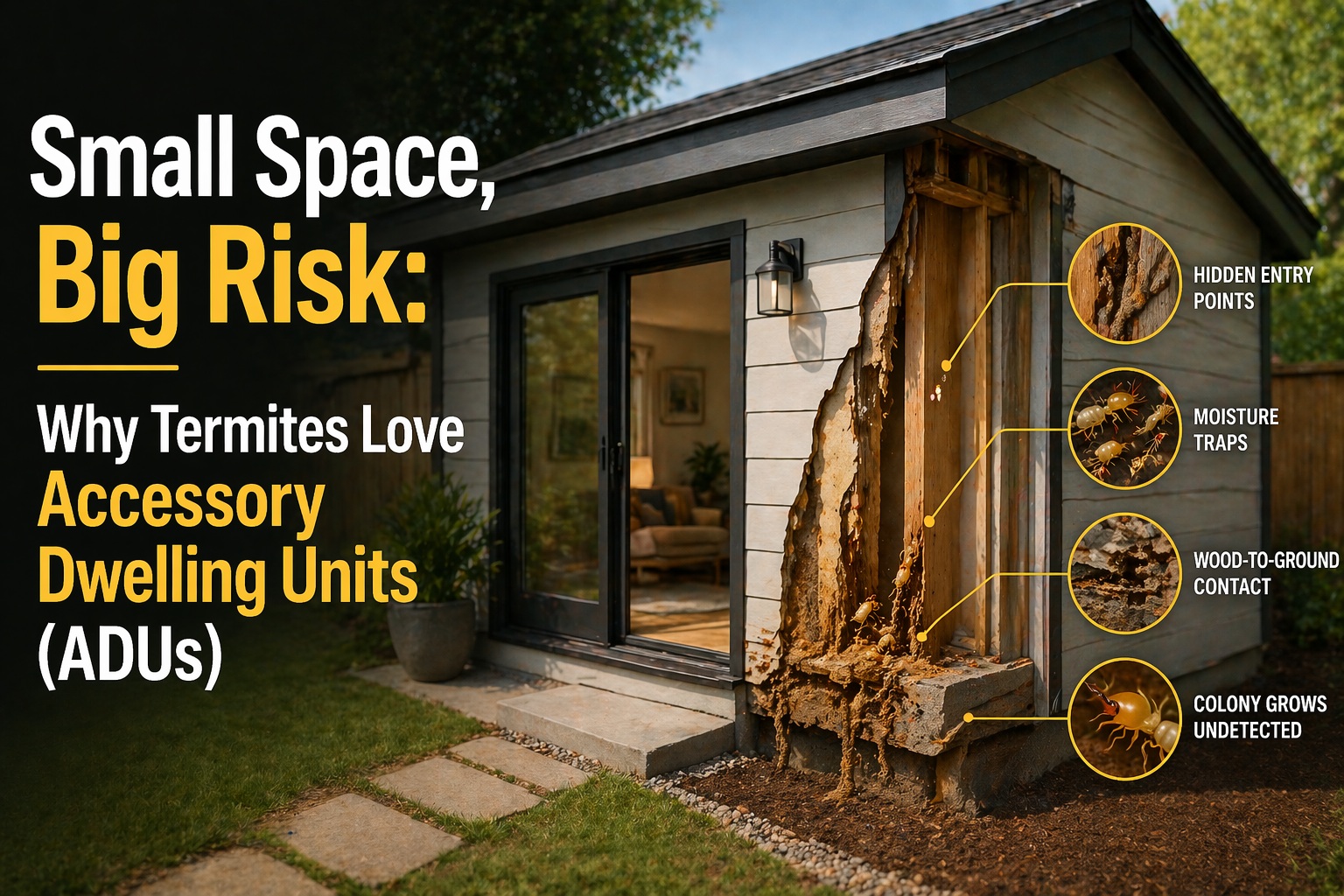 Accessory dwelling units (ADUs) are booming across the United States. From backyard cottages in California to garage conversions in Texas, homeowners are embracing these compact living spaces for rental income, multigenerational living, and property value growth.
But there’s a hidden problem many don’t see coming.
Termites.
These tiny, silent destroyers are increasingly targeting ADUs, and in many cases, causing faster, more severe damage than in primary homes.
Why ADUs Are Vulnerable to Termite Attack
1. Foundation Design Makes a Big Difference
Q: Why do foundations matter for termite risk?
Many ADUs are built using slab-on-grade or shallow foundations, often closer to the soil than traditional homes.
This creates:
- Easy access for subterranean termites
- Fewer barriers between soil and wood
- Increased humidity beneath the structure
2. Moisture: The #1 Termite Magnet
Q: What role does moisture play in termite infestations?
Termites cannot survive without moisture, and ADUs often trap it.
Common moisture sources in ADUs:
- Poor drainage systems
- Compact layouts with limited airflow
- Plumbing leaks in tight spaces
- Roof runoff near the foundation
Research from the University of California Agriculture & Natural Resources (UC ANR) confirms that moisture accumulation significantly increases termite activity, especially in smaller structures with limited ventilation.
3. Construction Shortcuts = Long-Term Risk
Q: Are ADUs built differently than main homes?
Often, yes.
ADUs are:
- Faster to build
- Budget-conscious
- Sometimes DIY or contractor-variable
Therefore, they may skip critical termite prevention steps like:
- Soil pre-treatment
- Proper vapor barriers
- Termite shields
A report by Freddie Mac (2020 ADU Guide) highlights that rapid ADU adoption has led to inconsistent construction standards, especially in secondary housing builds.
4. Wood-to-Soil Contact: A Silent Invitation
Q: Why is wood-to-soil contact dangerous?
It gives termites direct, invisible entry into your structure.
Common ADU mistakes:
- Wooden siding touching soil
- Deck posts without concrete separation
- Steps or skirting placed directly on the ground
According to the International Residential Code (IRC), wood components should be at least 6–8 inches above soil level to reduce termite risk.
5. Limited Inspection = Bigger Damage
Q: Are ADUs inspected less frequently?
Yes, and that’s a major problem.
ADUs are:
- Smaller
- Often rented out
- Not always owner-occupied
Hence, they tend to be:
- Checked less often
- Maintained reactively, not proactively
The National Pest Management Association states that termite damage often goes undetected for years, especially in less-frequented structures.
Explore This: Preventive Termite Inspection - What Is It and How Often Should I Do It?
Latest Trends & Insights
Q: Is termite risk increasing with ADU growth?
Yes, and recent industry observations confirm this:
- California surge: With ADU-friendly laws, pest control companies report increased termite calls in backyard units.
- Climate change impact: Warmer temperatures are expanding termite ranges northward.
- Urban density effect: Closer structures = faster spread between buildings.
A 2023 report from Pest Control Technology (PCT Magazine) noted that urban infill housing, including ADUs, is becoming a major hotspot for termite activity.
Signs Your ADU Might Have Termites
Q: What are the early warning signs?
Look for:
- Mud tubes along walls or foundation
- Hollow-sounding wood
- Discarded wings near windows
- Tight-fitting doors/windows (due to warping)
- Bubbling paint or damaged drywall
The EPA warns that termites are often mistaken for ants, delaying early detection.
Prevention: How to Protect Your ADU
Q: What are the most effective termite prevention methods?
1. Pre-Construction Protection
- Soil treatment with termiticides
- Install physical barriers
- Use pressure-treated wood
2. Moisture Control
- Fix leaks immediately
- Ensure proper drainage
- Install vapor barriers
3. Smart Design Choices
- Maintain clearance between soil and wood
- Improve ventilation
- Avoid wood mulch near the foundation
4. Regular Inspections
- At least once a year (recommended by NPMA)
- More frequently in high-risk states like California, Florida, Texas
Treatment Options (If You Already Have Termites)
Q: What should you do if termites are found in your ADU?
Common professional solutions:
- Liquid barrier treatments
- Baiting systems
- Wood treatments & injections
Consult with a professional from a certified termite control company to get the problem-specific treatment recommendation.
Why Professional Termite Control Matters
Q: Can DIY methods work?
Short answer: Rarely for full elimination.
DIY solutions may:
- Kill visible termites
- Miss the colony
- Allow reinfestation
Professional termite companies:
- Identify species
- Locate colony source
- Provide long-term protection plans
HiTech Termite Control
Your ADU might be small, but termites see it as prime real estate, no rent, all access. A little prevention now can save you from big, expensive headaches later. That’s where we at Hi Tech Termite come in, think of us as your home’s quiet bodyguards, keeping termites out for good. Ready to protect your space? Let’s make sure the only guests in your ADU are the ones you invited. Get in touch with us here.
FAQs
What attracts termites to ADUs?
Moisture, wood-to-soil contact, poor ventilation, and foundation proximity to soil, attract termites to ADUs.
Are ADUs more prone to termites?
Yes. Their compact design, moisture retention, and construction shortcuts increase vulnerability.
How do I prevent termites in my ADU?
Use soil treatment, control moisture, maintain wood clearance, and schedule annual inspections.
How fast can termites damage an ADU?
Significant damage can occur within months, especially in small structures.
Do I need a termite inspection for a new ADU?
Yes. Even new constructions are at risk without proper preventive measures.
Is Termite Damage Worse in ADUs?
Yes, because:
- Damage spreads faster in compact spaces
- Structural elements are closer together
- A single infestation affects a higher percentage of the structure
Termites can eat 24/7, and a single colony can consume up to 1 pound of wood per day (University of Kentucky Entomology Department).